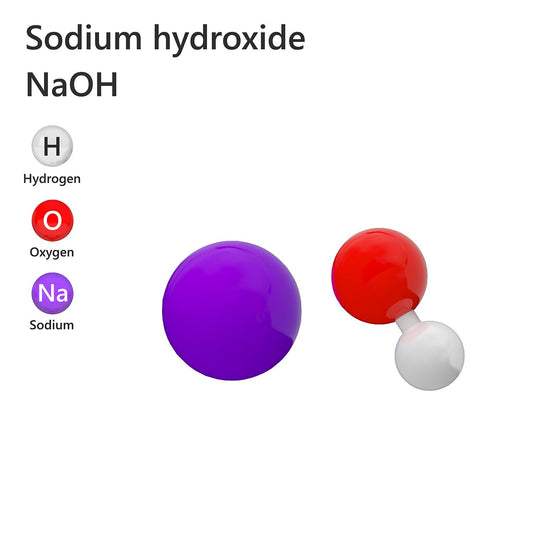
For a professional soapmaking business, choosing between caustic soda microbeads and 30% sodium hydroxide solution is more than a matter of production preference. It affects the amount of water added to the formulation, how the production workstation is organized, preparation-related risks, storage, and the actual cost of the sodium hydroxide used.
- The caustic soda microbeads, containing at least 99% NaOH in the products considered here, offer great formulation flexibility: the soapmaker determines the amount of water used to prepare the solution.
- The 30% sodium hydroxide solution contains 30% sodium hydroxide and 70% water. It is ready to use, eliminating the step of dissolving solid sodium hydroxide. However, this water must be accounted for in the soap formulation.
Sodium hydroxide microbeads or 30% sodium hydroxide solution: which should you choose for production?
For professional cold process soap production, the two options address different needs.
| Criterion |
Caustic soda microbeads (NaOH ≥ 99%) |
30% sodium hydroxide solution (30% NaOH, 70% water) |
|---|---|---|
| Preparation | Dissolution in water for each batch | Ready to use; no dissolution required |
| Reaction during preparation | Dissolution is highly exothermic. Allow time for the solution to cool before use. | No dissolution required: the solution is used directly at a temperature suitable for the process. |
| Dust and splashes | Risk of caustic dust during weighing and splashes during dissolution | No dust from solid sodium hydroxide; risk of splashing during handling |
| Flexibility in recipe water content | Complete: the formulator freely determines the amount of water and the concentration of the sodium hydroxide solution | Limited: a 30% solution already contains approximately 2.33 g of water per 1 g of NaOH |
| Cost per kg of active NaOH | Generally lower: the product contains at least 99% NaOH and very little water | Higher for an equivalent amount of active NaOH, since the solution contains 70% water |
| Storage | Hygroscopic product: keep the bag tightly closed in a dry location to prevent moisture absorption | Store in a suitable sealed drum or container; protect from freezing temperatures as recommended by the supplier |
| Weighing | Weigh by mass, accounting for the product’s actual purity | Weigh by mass, not measure by volume, accounting for the solution’s exact concentration |
| Suitable production setup | Soapmaking operations handling large volumes, using reduced-water recipes, or seeking precise control over sodium hydroxide concentration | Soapmaking operations seeking to eliminate the dissolution step, standardize preparation, and reduce handling of solid sodium hydroxide |
Many soapmakers use both:
- caustic soda microbeads for reduced-water formulations and large batches,
- the 30% sodium hydroxide solution for routine production or workstations staffed by operators in training.
Why use caustic soda microbeads?
Sodium hydroxide microbeads are particularly well suited to soapmakers who want complete control over the concentration of their alkaline solution.
The formulator measures the NaOH and water separately. This allows precise adjustment of the water-to-lye ratio to suit the formulation and manufacturing process.
This flexibility is particularly useful for reduced-water formulations, where a sodium hydroxide solution already diluted to 30% may add too much water.
It also offers a logistical advantage: unlike a solution that is 70% water, professionals transport primarily the active ingredient.
However, preparation requires a suitable workstation. Dissolution is highly exothermic, and a solution can exceed 60 °C.

Why choose a 30% sodium hydroxide solution?
The 30% sodium hydroxide solution already contains NaOH dissolved in water. It can therefore be weighed and added to the process without dissolving microbeads.
For a production facility, this eliminates the need for:
- handling and weighing solid sodium hydroxide, which may generate dust;
- the exothermic dissolution step;
- the time needed for the prepared solution to cool.
It may therefore be useful for workshops seeking to standardize the preparation workstation, particularly when several operators are involved in production.
Caution: a 30% solution is still corrosive. Using a ready-to-use solution does not eliminate the need for protective measures when handling NaOH.
How do you calculate a formulation using a 30% sodium hydroxide solution?
This is the key consideration when a recipe originally formulated with solid sodium hydroxide must be made using a 30% solution.
The solution contains:
30% NaOH + 70% water
To obtain a given mass of pure NaOH:
Mass of 30% sodium hydroxide solution = required mass of NaOH ÷ 0.30
Consider a formulation requiring 100 g of pure NaOH.
The amount of solution needed is:
100 ÷ 0.30 = 333.3 g of 30% sodium hydroxide solution
These 333.3 g contain:
100 g of NaOH + 233.3 g of water
Do not add all the water originally specified in the recipe to this amount.
Calculating the water to add
The formula becomes:
Water to add = total water specified in the recipe − water already supplied by the solution
A 30% solution thus provides approximately 2.33 g of water for every 1 g of NaOH.
This characteristic also sets a formulation limit: if the recipe requires an alkaline solution more concentrated than 30%, the solution already supplies more water than the formula can accommodate.
In this case, sodium hydroxide microbeads are more suitable.
- Always measure by mass, never by volume: sodium hydroxide solution has a density of approximately 1.33.
- Use the saponification values provided by your oil supplier, as they can vary between batches.
- Recalculate whenever you change the formulation, even if you substitute just one oil.
Safety: What precautions should you take with sodium hydroxide?
Choosing a ready-to-use solution does not make sodium hydroxide safe to handle.
Sodium hydroxide is classified as corrosive, and handling it calls for sealed safety goggles or a face shield, suitable long-cuff gloves, clothing that covers the body, a waterproof apron, and closed-toe shoes. Dust protection is also required when handling microbeads.
When preparing a solution from microbeads, the fundamental rule is: add the sodium hydroxide to the water, never the water to the sodium hydroxide. Add it gradually, into cold water, while stirring and in a properly ventilated area.
Equipment made of stainless steel, polypropylene, or HDPE is acceptable, but aluminum, zinc, and tin must be avoided: their reaction with sodium hydroxide can release flammable hydrogen gas.
Ecocert sodium hydroxide, E524, EN896: which grade is right for soapmaking?
Not all sodium hydroxide products meet the same standard.
For a professional soapmaking business, it is therefore important to distinguish the product’s concentration from its grade or regulatory verification.
| Product | Grade / standard | Who it’s for |
|---|---|---|
| Ecocert-verified caustic soda microbeads, made in France | Raw material verified by Ecocert Greenlife, compliant with ECODETERGENT and COSMOS (V3) | Certified soapmakers or those pursuing organic or natural certification; locally focused operations |
| Ecocert-verified 30% sodium hydroxide solution | Same standards | Certified soapmakers seeking to eliminate the dissolution step |
| Caustic soda microbeads, sourced from outside the EU | Technical grade, not Ecocert-verified | Non-certified soaps; cleaning and degreasing uses |
| 30% sodium hydroxide solution, food-grade E524 | Food additive | Food processing industry; no particular benefit for soapmaking |
| 30% sodium hydroxide solution EN896 | Drinking water treatment standard | Municipalities and water network operators; not intended for soapmaking |
In practice, a soapmaking business seeking COSMOS certification or Nature & Progrès certification must be able to provide a verification certificate for each raw material: request it with your order. The Ecocert grade does not change the calculations or safety requirements; it determines whether your application is accepted.
- Caustic soda is not washing soda crystals (sodium carbonate, which does not cause saponification).
- Caustic soda is not caustic potash (potassium hydroxide, used for liquid soaps and black soap).
Which sodium hydroxide should you choose for your soapmaking operation?
There is no single answer.
Choose sodium hydroxide microbeads instead when your priority is controlling the amount of water, making reduced-water formulations, or optimizing the cost of the active ingredient.
Choose a 30% sodium hydroxide solution instead when your priority is to eliminate the dissolution step and simplify the preparation workstation.
Both forms can also be used in the same soapmaking operation.